ChevyParts
My Garage
My Account
Cart
OEM Cadillac Catera Brake Disc
Disc Rotor- Select Vehicle by Model
- Select Vehicle by VIN
Select Vehicle by Model
orMake
Model
Year
Select Vehicle by VIN
For the most accurate results, select vehicle by your VIN (Vehicle Identification Number).
3 Brake Discs found
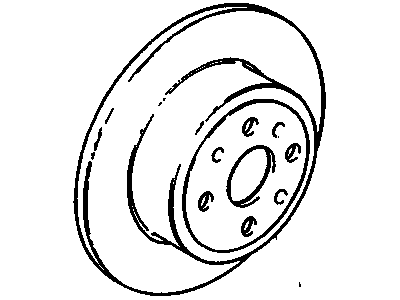
Cadillac Catera Rotor Part Number: 93182292
Cadillac Catera Rotor Part Number: 9195052

Cadillac Catera Rotor Part Number: 90392559
Cadillac Catera Brake Disc
Want to cut long-term maintenance and repair costs? Choose OEM Brake Disc. Those parts deliver top durability you can trust. On our site, you'll find a huge catalog of genuine Cadillac Catera parts. Prices are unbeatable, so you can keep more in your pocket. Every OEM Cadillac Catera Brake Disc includes a manufacturer's warranty. You can also get an easy return policy that keeps buying risk free. Fast delivery, get your car on the road quickly. It's simple to search, compare, and order. Stop guessing about quality or fit. Order today and save with parts that last.
Cadillac Catera Brake Disc is the professional part for Cadillac Catera, a luxurious sedan whose production ceased in 2001. With this Brake Disc kit, the braking system efficiency is preserved by the brake discs and pads that are crucial for the renewal and improvement of the system. The Cadillac Catera Brake Disc is produced with different car models of Catera in mind hence can suit any car owner who intends to upgrade his/her car safety system. The brake pads, specially the friction material used in them, are made for durability and performance on the road, and especially during aggressive driving. Also, the kit may contain required and optimal metal parts like clips and springs to maintain the functionality of the pads and reach the uniform wear that is paramount for the Cadillac Catera's braking system. The most memorable characteristic of Cadillac Catera Brake Disc is the improvement of efficiency and safety, so drivers will feel comfortable on the road. When Cadillac tried to rival the foreign luxury cars from Europe and Japan, from this series the Catera responded the call and the Brake Disc takes a vital function in enhancing the reliability of this luxury four-door sedan. All in all, Cadillac Catera Brake Disc is the kind of investment that any owner should never brushed aside, especially in order to keep their car a secure and good performing luxury cars on the metro's busy streets.
Cadillac Catera Brake Disc Parts and Q&A
- Q: How to replace the front brake disc on Cadillac Catera?A:To replace the front brake rotor, first, lift and support the vehicle, next, take off the tire and wheel. Take care because if brake fluid in the caliper becomes overheated; avoid cramming the contaminated fluid back into the brake system. Open bleeder screw and secure a tube to the catch container for the brake fluid. Compress Piston into the caliper housing bore to obtain clearance between linings and rotor. Do not bolt back, discard the caliper bracket bolts without twisting or crimping the brake hose or the Brake Pad wear sensor wire. Unscrew the caliper and bracket together using mechanic wire to hold them in position, then unscrew the brake rotor set screw and pull the brake rotor. Clean off any rust or other foreign objects from both the mating surface of the axle flange as well as the brake rotor to prevent increased lateral run out operation and brake pulsation. Follow the caliper bracket mounting threads in the Steering Knuckle to clear that the threads have no leftover locking compound then install the new brake rotor and then the brake rotor set screw, tightening it to 4 nm (35 inch lbs.). Mount the caliper and bracket to the Steering Knuckle with a new caliper bracket bolts coated with 272 threadlocker, gm p/n 12345493 or equivalent before installation and tighten to 95 nm (70 ft. Lbs.) first pass and 37 degrees second pass. Replace the tire and wheel, put the vehicle down, and fill the master cylinder reservoir. New braking surfaces need to be broken in or burnished upon mounting brake pads or refinishing rotors; avoid overheating the brakes. Lastly, make 20 stops from 48 km/h (30 mph) with medium to firm brake pedal pressure in order to burnish brake rotors.
- Q: Under What Conditions Should Brake Discs Be Refinished on Cadillac Catera?A:Brake rotor refinishing must be performed only in particular situations which include brake surface scoring beyond 1.5 mm (0.060 inches) or when rotor thickness variation reaches 0.025 mm (0.001 inches) or when corrosion affects areas deeper than the braking surface. The approved brake lathes for servicing include accu turn (R) off-vehicle and pro-cut (R) that operates on the vehicle. Hubs need the j 42450-a hub cleaning kit together with the j 41013 rotor resurfacing tool kit for tool requirements. During brake rotor separation from wheel bearing flange it is crucial to employ the j 42450-a for cleaning rust as well as any extraneous material from mating surfaces. The first step involves cleaning the wheel bearing/hub with j 42450-a followed by measuring the thinnest rotor brake point with a micrometer. Refinishing the rotor should only occur if the measurement exceeds the minimum specification; otherwise replace the rotor next to refinishing. Adopt the j 41013 rotor resurfacing kit for complete rust removal from brake rotor flanges before executing rotor refinishing by following manufacturer protocols. Apply 120 grit aluminum oxide sandpaper to produce a non-directional surface on the braking area while using a non-directional rotor finisher if available followed by cleaning with denatured alcohol or suitable brake cleaner. Proper brake performance depends on steering wheel nut torque uniformity when it reaches the designated specification. The process of burnishing new braking surfaces requires the driver to make 20 stops beginning at 48 km/h (30 mph) using medium to firm pressure on the brake pedal and staying away from overheating the brakes.
Related Cadillac Catera Parts
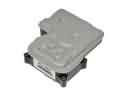 Cadillac Catera ABS Control Module
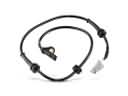 Cadillac Catera ABS Sensor
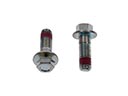 Cadillac Catera Brake Caliper Bolt
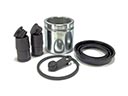 Cadillac Catera Brake Caliper Repair Kit
 Cadillac Catera Brake Calipers
 Cadillac Catera Brake Master Cylinder
 Cadillac Catera Hydraulic Hose
 Cadillac Catera Parking Brake Cable
 Cadillac Catera Parking Brake Shoe
 Cadillac Catera Spindle Nut
 Cadillac Catera Wheel Hub Bolt
 Cadillac Catera Wheel Speed Sensor